By Fahad, Content team at Techmelogy· [Updated on 14 Nov’2026]
Picture a purchase manager in Pune. Someone told him about your unit in Bawana, or he saw your name on IndiaMART. Before he picks up the phone, he types your company name into Google on his phone. He gives it maybe a minute.
If what he finds looks like a trader's brochure, he moves on. You never even learn he looked.
That minute is the whole reason to have a website for manufacturers in Delhi. Not "digital presence", not a fancy banner. The site has to tell a stranger one thing quickly: this is a real factory, it makes what I need, and these people will pick up the phone.
We're Techmelogy, a web development agency in Delhi. We've been at this for 10+ years, with 430+ websites delivered (see our work) across 20+ industries, and manufacturing and B2B is one of them. What follows is how we think about building a site for a factory, and where we think most agencies get it wrong.
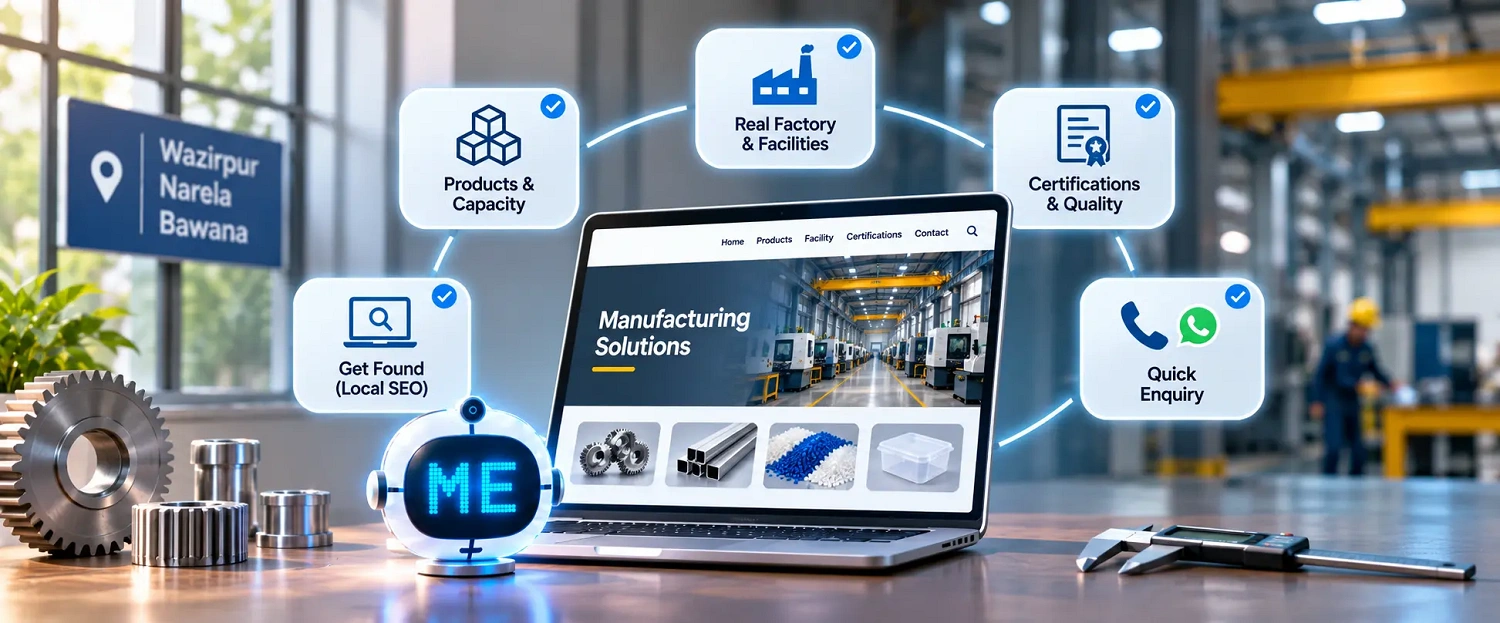
A manufacturer's website needs to do five things. Prove the factory is real. Show what you make and how much you can make. Let a buyer ask for a quote in under a minute. Show up when someone searches for your product plus your area. And load fast on an ordinary phone with a slow connection. If it does those five, it's good. Anything beyond that is nice to have.
Agencies love writing "Delhi manufacturers" as if it were one crowd. It isn't. A steel dealer in Wazirpur and a packaging supplier in Bawana have different buyers and different worries, so their websites shouldn't open the same way.
| Wazirpur | Narela | Bawana | |
|---|---|---|---|
| Usually makes | Stainless steel, metal sheets, utensils, hardware, metal processing | Packaging, plastics, food and FMCG, garments, general engineering | Plastics and polymers, packaging, electronics and components, rubber, garments |
| Who's buying | Traders, dealers, fabricators across North India | Brand owners, wholesalers, institutional buyers | OEM purchase teams, exporters, bulk B2B buyers |
| What worries the buyer | Is the grade and thickness really what you say? | Can you repeat the same quality batch after batch? | Do you have the certificates my QA team will ask for? |
| Put first on the homepage | Grades, sizes, thickness range, stock | Batch capacity, packaging options, private label | Certifications, tolerances, how to get a sample |
| What convinces them | Mill test certificates, photos of real stock | A short video of your plant and process | Machine list, inspection reports, client names |
So a Wazirpur site should show a stock and grade table before anything else. A Bawana site should have the certificates and a sample request near the top. Same agency, two different layouts.
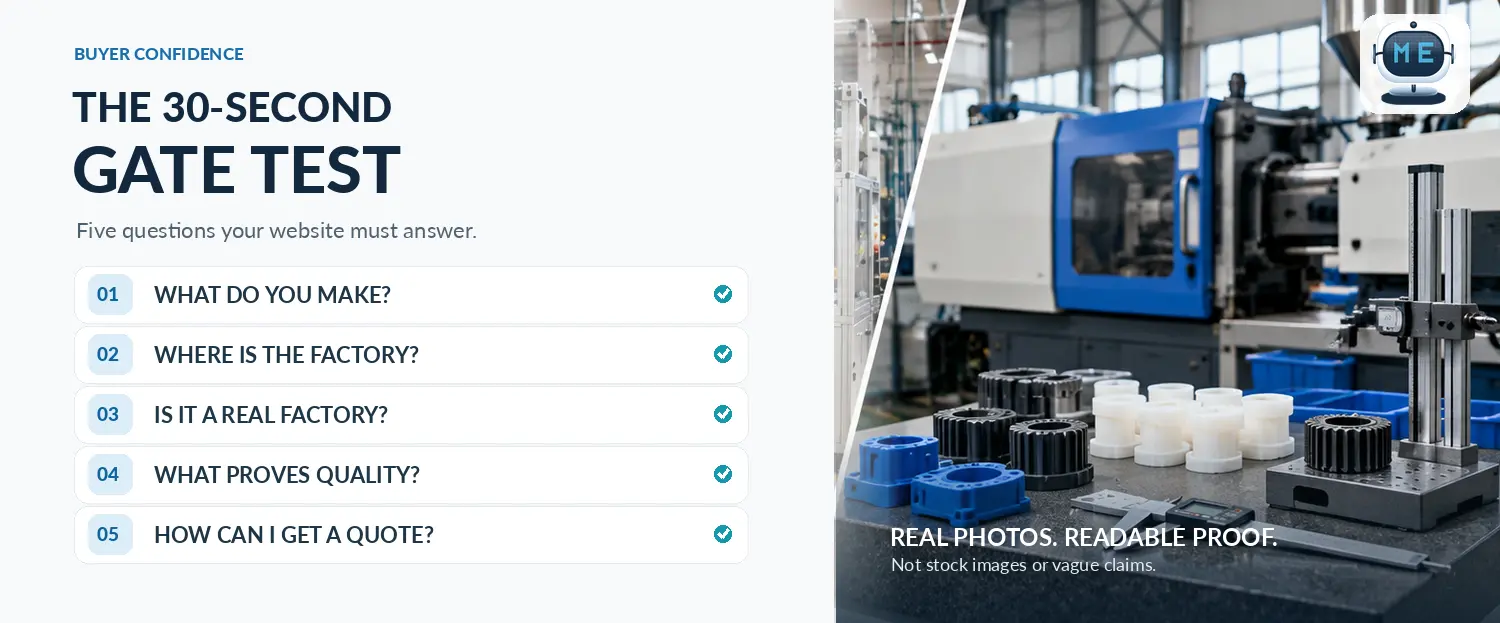
We use a simple check when we look at a factory's website. We call it the Gate Test. Pretend there's a guard at your factory gate who only lets serious buyers in. Your website has to be that guard.
Give your site a 1 or 0 for each. If you score less than 4, you're losing enquiries, however good it looks.
For example: A client by name of Omex Gears came to us around January 2026 with a score of 1 out of 5. They were in the manufacturing of gear boxes. They already had the website, but it was missing the most important part that their potential client would love to see, when they land on the website.
They wanted to see about the precision and quality of their products, we tackled this by showing their ISO certification, their customer testimonials and their awards and accreditations, all this in first 3 scroll. Next they wanted to know about the pricing, this was handled by providing a floating WhatsApp icon and call button, so the potential client can reach through text or call.
Another point was about their goodwill and their expertise, since Omex Gears had been in the market for 21 years, we put an emblem saying “21 Years of Engineering Excellence” write next to the logo on the header. After making these changes the result was amazing, potential client who visited the website got to know in first 5 seconds, that the company have been producing exceptional quality of Gears since last 21 years, supported by an ISO certification which is backed by real clients testimonials. All that was left for the client was to get in touch to discuss the price and even for that they don’t have to go further, because there already exist a WhatsApp floating icon and call button. The company witnessed a 68% rise in enquiry.
Homepage. Lead with the product, then the promise. Add a short headline, three to six main products, your certificates, the address, a WhatsApp button and the quote form.
One page for each product family. This is where most of your search traffic will come from. A page called "SS 304 Coil Supplier in Wazirpur" will beat a single "Products" page every time. On each one, put sizes or grades, where the product is used, minimum order quantity, lead time and a quote button.
Capabilities. List your machines with make and capacity, plant area, monthly output and inspection equipment. Serious buyers read this page more carefully than the About page.
Quality and certificates. Show them as images people can actually read, and explain your inspection process in a few lines. If you hold a registration a buyer can verify, show the number. The usual ones to look at are ISO 9001 for quality systems and, for products that need it, BIS certification.
Clients and industries. Name clients if they've allowed it. If not, say which sectors you serve and the typical order size.
Contact and visit. Full address, map, working hours, and an open invitation to come and audit the factory. Few things build trust faster.
A catalogue to download. Fine to offer, but don't let it replace web pages. A PDF can't rank for a product search the way a proper page can.
Nobody types "website for manufacturers." They type what they need, and usually the place:
So the plan for a Delhi factory goes like this. One product, one page. Put the industrial area in your titles and headings where it's true, and don't list twenty areas you don't serve. Claim your Google Business Profile with the exact plot address, the right category and real photos, and keep the name, address and phone number identical everywhere online. Add schema markup for your business and products, following Google's guides for Organization, LocalBusiness and Product structured data. Keep your IndiaMART and TradeIndia listings for leads, but make sure they link back to your own site, because you rent that visibility and the site is yours.
And write for proof, not volume. One article on how you inspect a batch is worth more than ten on "why quality matters." Google says the same in its guidance on creating helpful, people-first content. If you want a hand with the search side, that's our SEO service, and we've broken down what it costs in Local SEO cost in Delhi.
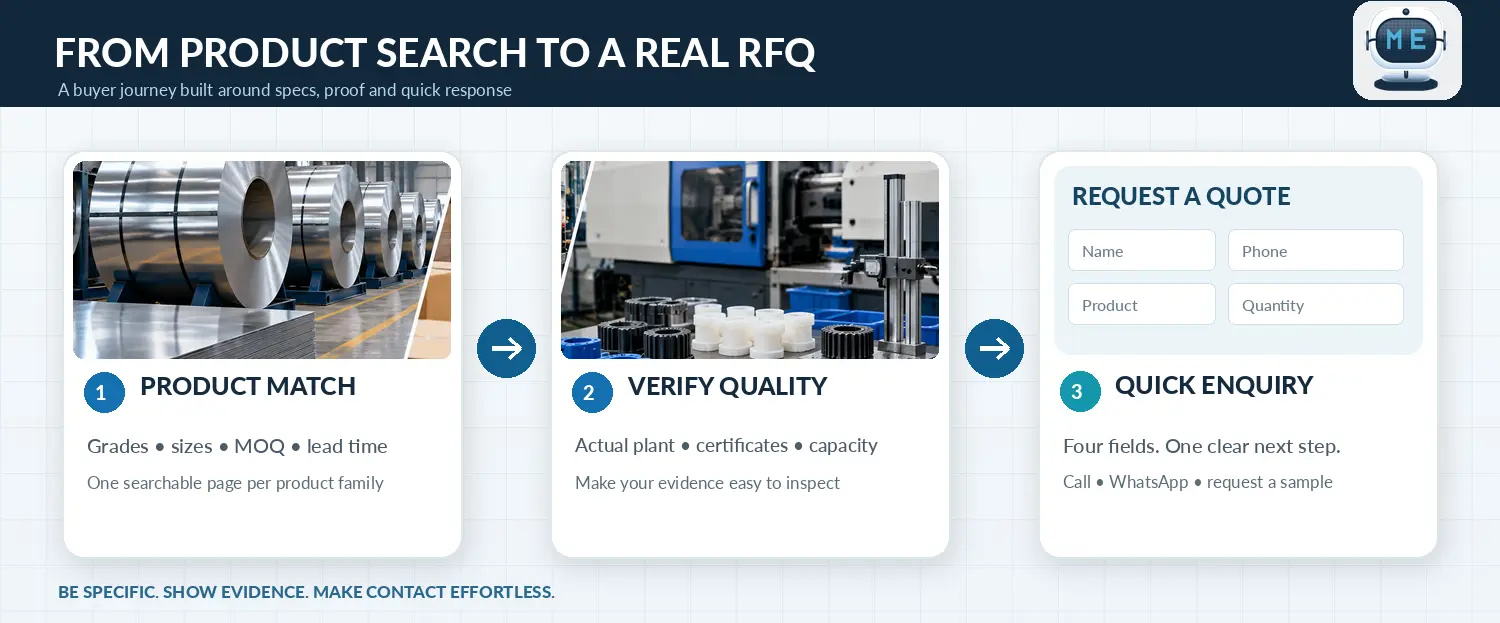
There is a pattern of mistakes that we keep running into, when we are onboarding a new client for their web development. Most of the websites are not Mobile first, they are build for desktop. In a time when 90% of the trade takes place on smart phone, a website that’s not build for mobile first will be going to loose customer. Another thing which we notice is that website is not structured in a way it should be. There should be conceptual flow of data and information which your customer want to see. They first want to know about your quality of the product, price of your product, followed by testimonials and so on. One other major issue which we see is very bad use of CTA’s. Call to Action is an important part and most of the existing website which we see, makes very little use of it.
Every Techmelogy project goes through the same six stages. For a factory, they look like this.
Two things we promise every client. You own your domain, hosting and source files. And the quote spells out scope and deliverables in writing.
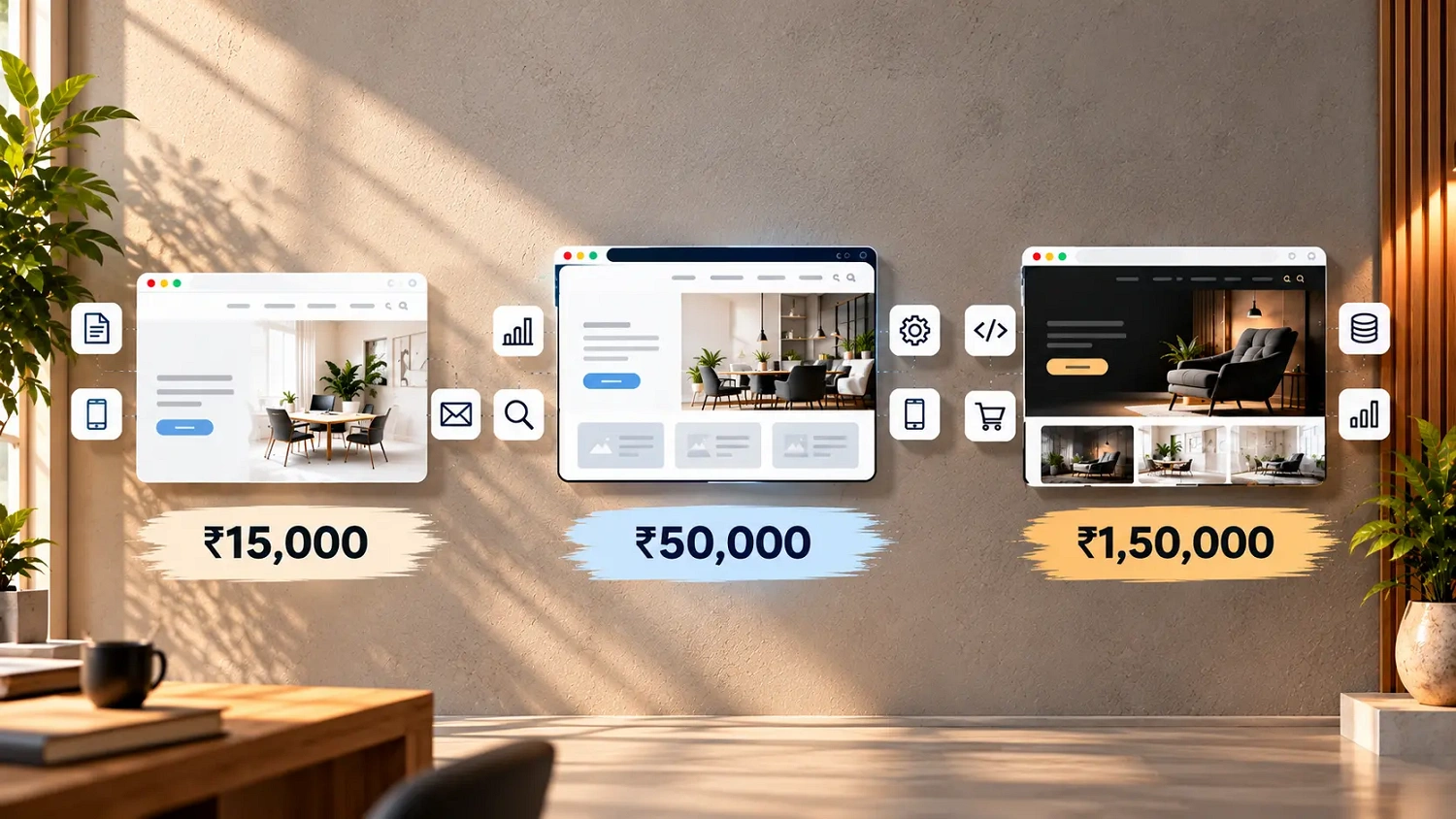
These are our 2026 price bands in Delhi.
| Package | Typical range | Suits a factory that... |
|---|---|---|
| Basic business website | ₹15,000 to ₹40,000 | is new online and needs a credible presence: home, about, a few products, contact |
| Custom SEO-ready website with CMS | ₹40,000 to ₹95,000 | wants RFQs: product-family pages, capability and certificate pages, enquiry flow, on-page SEO |
| Ecommerce or custom web application | ₹45,000 to ₹1,50,000 and up | sells online, or needs a dealer portal, order tracking or integrations |
Most manufacturers in Wazirpur, Narela and Bawana who want B2B enquiries end up in the middle band. If someone quotes you ₹5,000, it's almost always a recycled template with no SEO and no support, and you'll pay again within a year to rebuild it. We've written a longer breakdown in our guide to the 5 page website cost in Delhi, and the trade-offs in cheap vs custom websites.
What pushes a price up or down: the number of product pages, how ready your photos, specs and certificates are, whether you need more than one language, and whether you want the site connected to your CRM or WhatsApp Business.
If buyers outside your own circle find you through search, WhatsApp forwards or marketplaces, yes. It's the only place where you decide what they see about your plant, certificates and capacity.
It brings leads, but you're renting the visibility. A site you own keeps building ranking and trust, and it doesn't vanish when a plan expires.
Start with a homepage, a page for each main product family, capabilities, quality, about and contact. That's usually 8 to 15 pages. Add more only when you have real specs and photos for them.
It can, if it shows certifications, export documentation, packing and shipping options, in clear English. Overseas buyers check suppliers online long before they call.
You need both, but in this order: clarity, speed, proof, then looks. A plain site that passes the Gate Test beats a flashy one that doesn't.
From your existing network and WhatsApp, often at launch. Search rankings for a product plus an area usually take a few months. We'd rather tell you that honestly than promise a date.
Send us your current website or marketplace link and your plot address in Wazirpur, Narela or Bawana. We'll run the Gate Test and tell you the first three things to fix, free. Get my Gate Test score, or contact us directly.
Techmelogy · +91 96257 03807 · info@techmelogy.com · www.techmelogy.com · 415, Usha Kiran Bldg Rd, Commercial Complex, Gopal Nagar, Azadpur, Delhi 110033